
How Much Vitamin D In Raw Milk
 By Jim Roberts
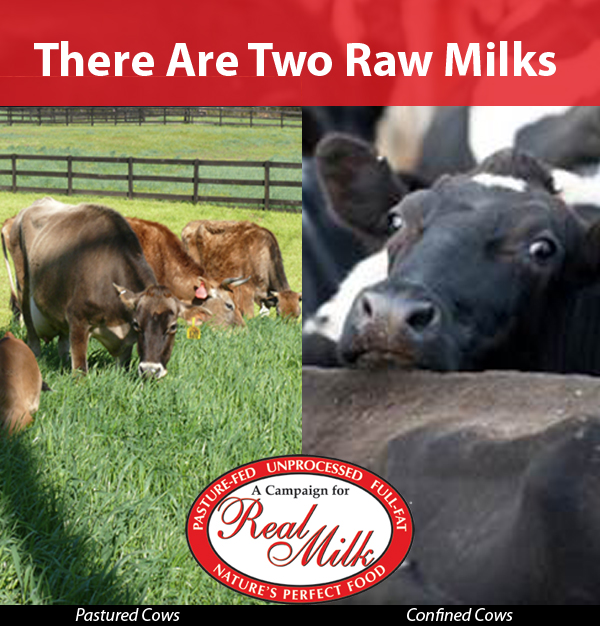
Consumers are willing to pay for the other one. Departments of Health want to ban both.
- For benefits of raw milk see www.realmilk.com.
- For a response to the FDA/CDC Reminder on the Dangers of Drinking Raw Milk, see our press release: FDA and CDC Bias Against Raw Milk–No Facts Provided in Recent Reminder about Raw Milk Consumption
- For a response to the ABC News Story, see: The Raw Milk Movement: Healthy or Hazardous?
Let's review the different conditions affecting raw milk quality.
| CONDITIONS AFFECTING RAW MILK QUALITY | THE OTHER RAW MILK PRODUCED FOR DIRECT CONSUMPTION | RAW MILK PRODUCED FOR PASTEURIZATION |
| Diet Base (1) | Grass-based diet promotes alkaline conditions conducive to beneficial organisms | Grain-based diet promotes acid conditions conducive to pathogenic organisms |
| Living Environment (2) | Mostly on pasture | Mostly confined |
| Additional Intervention (3) | Rarely used | Bovine growth hormones |
| Life Span (4) | 12+ years | 3.5 years |
| Nutritional Quality (5) | 5 to 6 times more CLA Higher vitamin content Vitamin D from the sun | Minimal CLA |
| Farmer's family consumes the milk (6) | YES | NO |
| Consumer Willing to Pay a Premium Price | YES | NO |
We need the liberty to be able to purchase the OTHER quality raw milk that has been produced with the goal of direct human consumption. And we agree with the health department experts on one point, we don't want the raw milk that requires pasteurization.
REFERENCES:
(1) Diet Base: "Ruminant animals have four stomachs and are evolutionarily adapted to eat pasture, browse and other plants. Today's dairy cows are nutritionally depleted and stressed by producing huge quantities of milk. To survive they need a lot to eat, so forage is supplemented with grains. When cows are fed grains, the rumen pH lowers, microbes change and the animal's health (also milk and meat) is adversely affected, and cows eating large amounts of grain can even die." (Raising Healthy Dairy Cows edited by Sandra Redemske. Raw Milk Resource Guide, 2003).
Though cows are naturally grass-feeding animals, 85-95% of dairy cows are raised in confinement on a diet of grain, particularly corn, because it is far more cost-efficient for agribusiness. Because this grain-based diet is highly abnormal and disruptive, it changes the pH in cows. This then sets up an environment and terrain in the cow for many abnormal physiological conditions that can increase the need for antibiotics. Further, to promote faster growth and more excessive milk production, many of these dairy cows are fed a variety growth hormones. All of this makes for the severely unhealthy dairy products that you'll find on virtually all grocery store shelves. (http://www.mercola.com/forms/cheese.htm)
"We have an industrial system of agriculture that puts our dairy cows inside on cement all their lives and gives them foods that cows are not designed to eat–grain, soy, citrus peel cake and bakery waste." (Dirty Secrets of the Food Processing Industry)
"Commercial grains (soy, corn, and cottonseed) fed to cows can contain genetically modified organisms (GMOs) and pesticide residues. Mycotoxins from mold in stored grains can pass into the milk and adversely affect the health of the cow. If organic farmers feed grains, they are certified organic, GMO-free and pesticide-free." (Raising Healthy Dairy Cows edited by Sandra Redemske. Raw Milk Resource Guide, 2003).
(2) Living Environment: "Permanent pastures managed intensively provide cows with a 'salad' of 20 to 30 or more different plant species. This biodiversity means that some plants will grow, even if the weather is hot, cold, wet, or dry. Access to hedgerow plants, and brushy/wooded areas add necessary nutritional variety to the cow's diet." (Raising Healthy Dairy Cows edited by Sandra Redemske. Raw Milk Resource Guide, 2003).
"In modern 'confinement dairies', food is brought to the cows that are confined in a building or outside paddock area. They do not graze in pastures eating fresh grass. (Raising Healthy Dairy Cows edited by Sandra Redemske. Raw Milk Resource Guide, 2003).
Any grain supplementation should be non-GMO (not genetically modified) and pesticide free.
(3) Additional Intervention: "Natural supplements can be used to meet the nutritional needs of the animal, such as kelp, salt, mineral salt and/or licks. Livestock diseases are prevented through adequate nutrition, proper sanitation, reduction of animal stress, access to pasture and holistic health care, parasite control by fecal exams, good pasture management, maintaining clean facilities and culling seriously infected animals. When necessary [for organic cows] use biological control methods such as herbs, diatomaceous earth and rock powders.
"Antibiotics and hormones are routinely given to confinement-fed cows to improve growth rates and counter illness caused by stress, inadequate nutrition, large concentrations of cows and inhumane conditions. This has contributed to the decreasing effectiveness of antibiotics as pathogens have become increasingly resistant to antibiotics." (Raising Healthy Dairy Cows edited by Sandra Redemske. Raw Milk Resource Guide, 2003).
(4) Life Span: "In the past, because the cows produced a moderate amount of milk and were allowed to go dry during the winter, they easily maintained excellent health and lived a long (12+ years), productive life."
Modern dairy farmers who want to produce high-quality milk vs. simply a high volume of milk care for their herds similarly.
"Today, most milk cows have been bred to produce three times as much milk as the old-fashioned cow. The more milk a cow produces, the more dilute is its vitamin content. Genetic selection in cows for increased milk production has caused the need for special feed, supplements, and an increasing number of vaccines and visits by the vet. The average life span of the modern factory cow is 3.5 years and her milk can contain high levels of pituitary growth hormone." (Raising Healthy Dairy Cows edited by Sandra Redemske. Raw Milk Resource Guide, 2003).
(5) Nutritional Quality: Conjugated Linoleic Acid (CLA)– Grass-fed dairy contains five times more CLA than grain-fed! CLA is among the most potent cancer fighters in all foods and offers other health benefits as well. (http://www.mercola.com/forms/cheese.htm)
Ruminants whose stomachs contain microorganisms, transform indigestible materials like cellulose into nutritious food. Forage is swallowed into the rumen for fermentation. The larger coarse forage is regurgitated, rechewed, and swallowed back into the rumen. Microorganisms in the rumen produce amino acids essential for making proteins, energy nutrients, vitamin K and B-complex vitamins." (Raising Healthy Dairy Cows edited by Sandra Redemske. Raw Milk Resource Guide, 2003).
Grass-fed dairy is higher in all the vitamins (it's four times higher in Vitamin E, for instance) in part because fresh pasture provides more of these nutrients than grains. Another reason is because cows on grass naturally produce considerably less milk than those fed grain. These yields of milk from grass-fed cows are part of the reason almost all agribusiness has shifted to grain feeding (greater yield = more money for them), but the dairy from grass-fed cows is a great blessing for you. (http://www.mercola.com/forms/cheese.htm)
"The fat-soluble vitamins (vitamin A, vitamin D and vitamin K), which occur in the fat of grass-fed animals, support endocrine function and protect against inflammation. Stress has also been cited as a cause of heart disease. Vitamin A is needed for the conversion of cholesterol into steroid hormones and, in fact, is rapidly depleted by stress. Vitamin D helps prevent high blood pressure and protects against spasms that can lead to a heart attack. As vitamin D is needed for calcium absorption, it contributes to a healthy nervous system and helps prevent arrhythmias." (Splendor from the Grass)
"… without the vitamins present in animal fats (vitamins A and D), you cannot assimilate minerals and other vitamins. You can be taking mineral supplements, drinking green juices or eating organic food until it comes out your ears, but you cannot absorb the minerals in your food without vitamins A and D that are exclusively found in the animal fats." (Dirty Secrets of the Food Processing Industry)
(6) Farmer's Family Consumes the Milk: The farmers know how their milk was developed. Some Grade A farmers do not allow their families to consume their milk for one reason or another. The raw milk you consider should be one that the farmer's family also consumes.
How Much Vitamin D In Raw Milk
Source: https://www.realmilk.com/there-are-two-raw-milks/


Tidak ada komentar:
Posting Komentar